





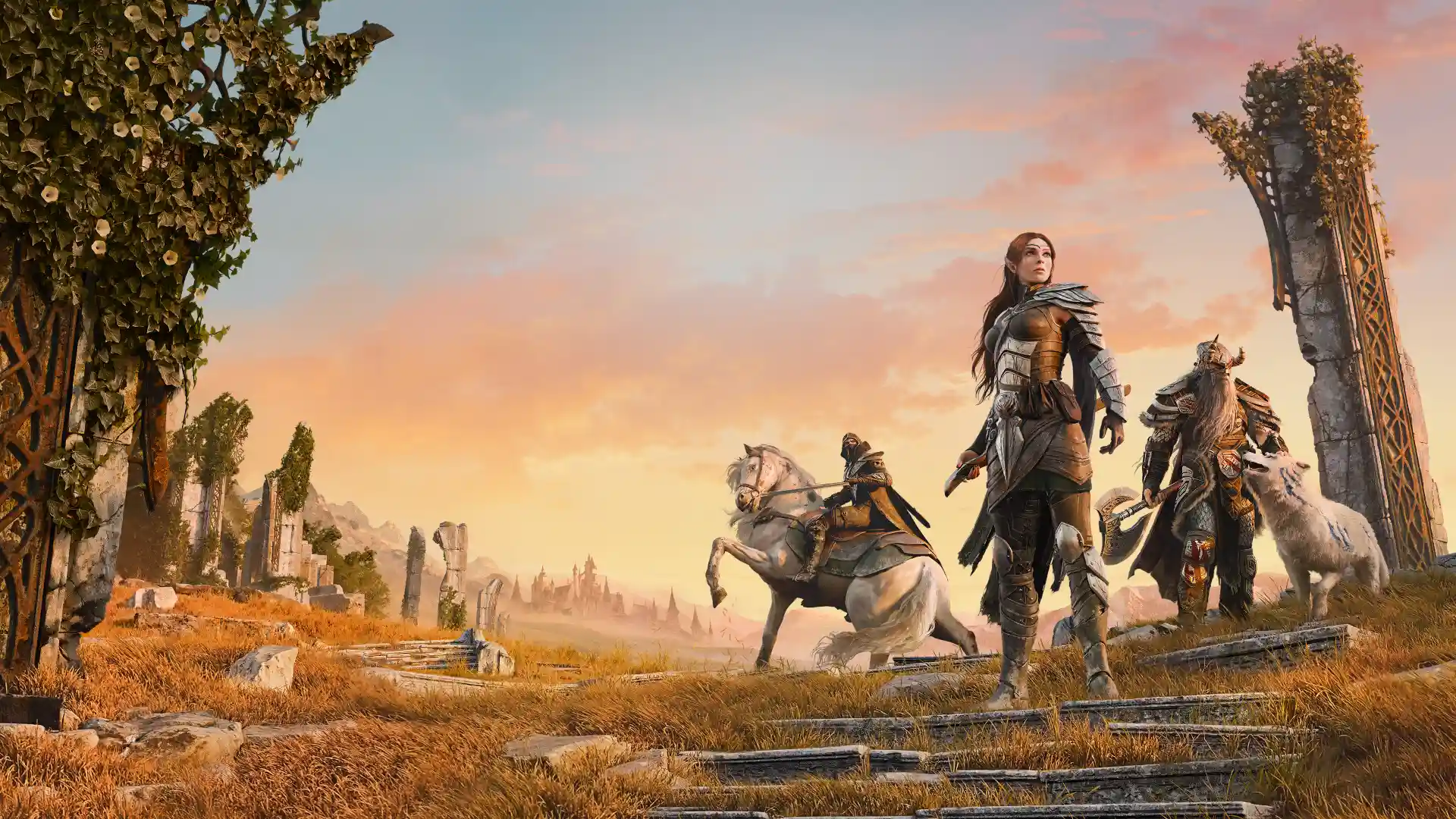
When The Elder Scrolls Online launched in 2014, it had a difficult question to answer: could one of gaming's most beloved single-player RPG worlds really work as an MMO? Fans were understandably cautious. The Elder Scrolls series had built its reputation around wandering through Tamriel alone, stumbling across hidden caves, discovering unexpected quests, and creating a character who felt uniquely their own. Turning that experience into a shared online world was never going to be easy.Yet 12 years later, ESO has become something much bigger than an online adaptation of Skyrim or Oblivion.
It has grown into its own version of Tamriel, filled with years of stories, expansions, homes to build, factions to join, characters to create, and countless places to explore. And now, the MMO appears to be entering another interesting phase. In a recent interview with GamesRadar, ESO game director Nick Giacomini described the game as experiencing something of a "renaissance." Recent player numbers appear to support that idea, with ESO reaching a new 30-day peak on Steam, according to SteamDB. But the game's renewed momentum isn't simply about more people returning to an old MMO. After more than a decade of updates and expansions, ZeniMax Online Studios is changing the way ESO evolves, with a greater focus on accessibility, experimentation, and giving players new reasons to explore its enormous world.
The Elder Scrolls Online wasn't an immediate success. Its original version felt noticeably different from the single-player games that had made the franchise famous. The MMO structure was more rigid, the combat divided players, and progression sometimes seemed to take priority over the spontaneous exploration that fans associated with The Elder Scrolls. For players accustomed to getting lost in Skyrim or wandering into an unexpected quest in Oblivion, ESO initially had to prove that a Tamriel shared with thousands of other players could still feel personal.
ZeniMax eventually began reshaping the game around that idea. One of the biggest turning points came with One Tamriel in 2016. The update removed many of the restrictions that had previously limited how players explored the world, allowing them to visit zones in a much more flexible order and adventure with friends regardless of their levels or alliances. It was an important lesson for ESO: sometimes the best way to improve a huge online world isn't to add another destination, but to make the existing one easier and more enjoyable to experience. Later expansions continued building on that philosophy, giving players new regions, stories, characters, housing options, and other ways to make Tamriel feel like their own.
ESO's longevity is impressive, but surviving for more than a decade creates its own problems.For a new player, the sheer amount of content can be intimidating. There are years of expansions, systems, currencies, progression options, quests, and mechanics to understand. Even returning players can find themselves feeling like they've walked into a completely different game after spending several years away. That enormous history is also one of ESO's greatest strengths, however.The game doesn't need to convince players that there's nothing else to do. Quite the opposite: there's an almost overwhelming amount waiting for anyone willing to explore it.
The challenge for ZeniMax is making all of that content feel inviting rather than overwhelming.And that challenge has become even more important as the studio moves away from the formula that carried ESO for much of the last decade. A major chapter would arrive, another part of Tamriel would open up, a new story would unfold, and players would eventually begin looking toward the next year's expansion. That approach worked remarkably well. It gave players a predictable stream of substantial content and helped ESO grow into one of the most established MMOs on the market.
But after nearly a decade, even that successful formula started to feel familiar. ZeniMax has acknowledged that players found the chapter structure increasingly "too formulaic," while the development team wanted more freedom to experiment.
That's where ESO's move toward Seasons in 2026 becomes particularly important.Rather than simply delivering another traditional chapter, Season Zero introduced an event zone, player-experience improvements, class and combat changes, Tamriel Tomes, and a new reward structure. Season One has gone even further with High Seas of Tamriel, introducing ideas such as naval combat and underwater exploration.
Those additions are important not just because they're new features, but because they demonstrate a willingness to experiment with what an ESO update can actually be. After 12 years, ZeniMax isn't simply adding more Elder Scrolls Online. It's trying to make the game feel less predictable.That's what makes the game's current resurgence particularly interesting. A spike in players can happen for all sorts of reasons. A major update, a promotion, or renewed interest in a franchise can temporarily bring people back. But ESO's current direction suggests that something more lasting may be happening.
The MMO has repeatedly reinvented itself when its existing structure started holding it back. One Tamriel changed how players explored the world. Years of expansions expanded Tamriel far beyond what existed at launch. Now, the seasonal model is giving ZeniMax more freedom to experiment with how content is delivered. That willingness to change may ultimately be more important than any individual player-count milestone. After all, keeping an MMO alive for 12 years isn't simply about producing enough content. It's about understanding when the game needs to change.ESO has already gone through several different identities since 2014. What began as an uncertain attempt to turn The Elder Scrolls into an MMO has gradually become one of the longest-running versions of Tamriel.
Now, with player interest rising and ZeniMax deliberately moving away from its old formula, the game may be entering another chapter of its own. And if this really is ESO's renaissance, the most interesting part may be that Tamriel still has plenty of room left to surprise its players.